Conveyor Belt Carcass Fabrics: Impact Resistance, Ply Adhesion, and Low Elongation Explained
The carcass is the structural backbone of any conveyor belt. It absorbs impact energy, resists tension, maintains troughability, and holds the belt together under extreme conditions. Without a properly engineered carcass fabric, belts stretch, delaminate, tear, or fail prematurely — causing costly downtime and material spillage.
At Weixin, we manufacture polyester conveyor belt carcass fabrics that deliver three critical performance properties: impact resistance, ply adhesion, and low elongation. This guide explains each property, why it matters, and how Weixin fabrics are engineered to excel.
What Is a Conveyor Belt Carcass?
The carcass is the reinforcement layer between the top cover and bottom cover of a conveyor belt. It provides:
| Function | Description |
|---|---|
| Tensile strength | Carries the load along the belt length |
| Impact resistance | Absorbs energy from falling materials |
| Troughability | Allows belt to form a U-shape on idlers |
| Dimensional stability | Maintains length and width under tension |
| Ply integrity | Keeps multiple plies bonded together |
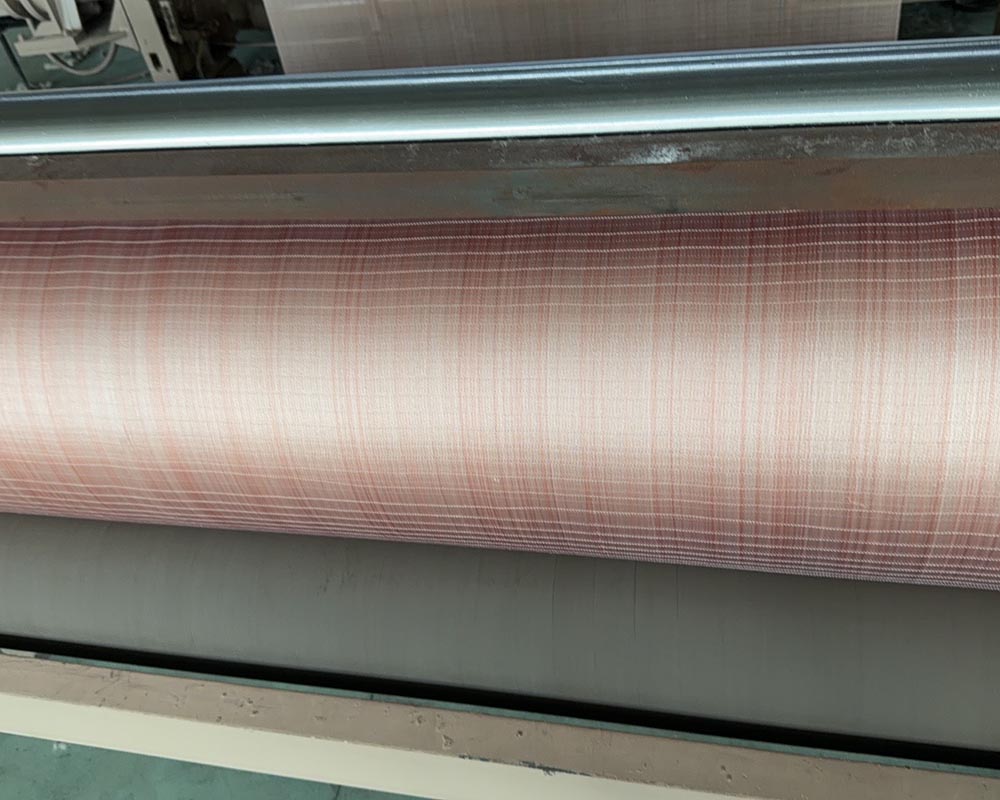
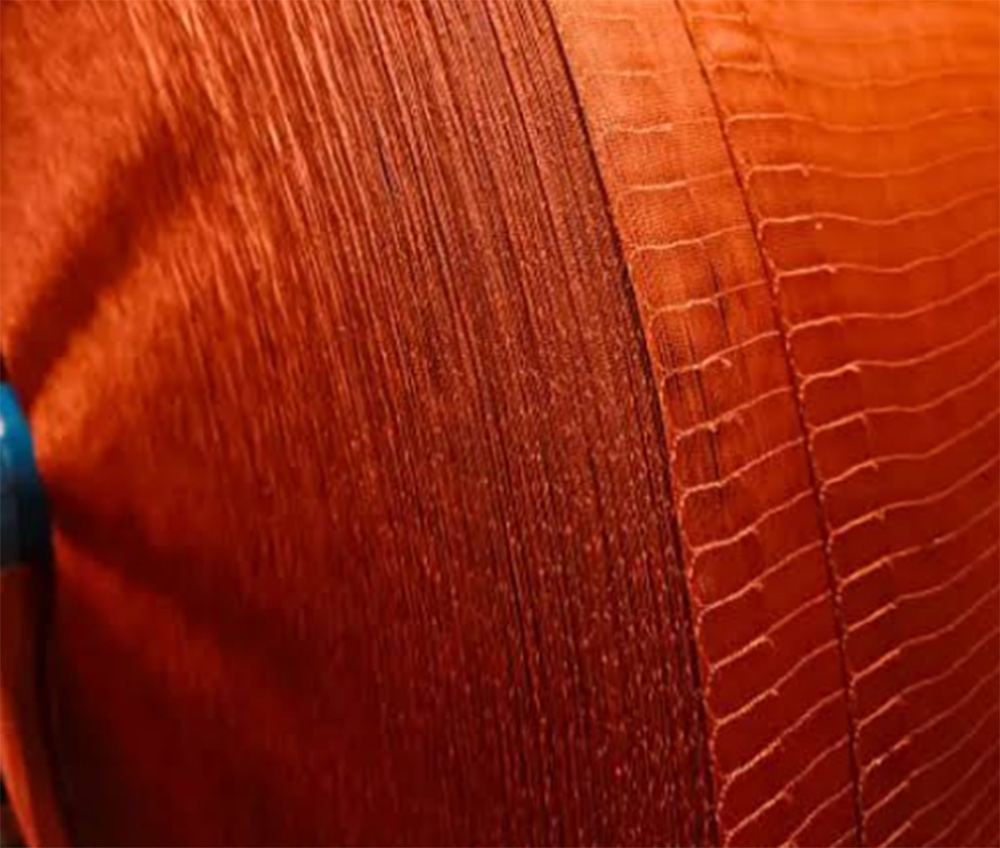
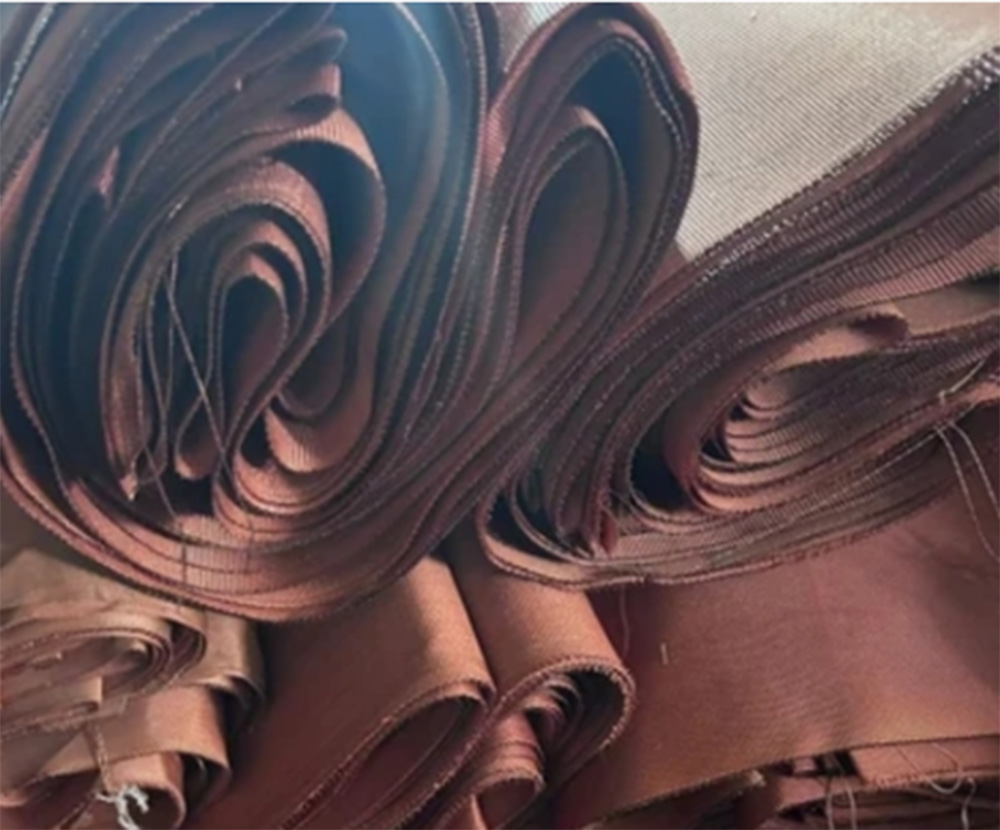
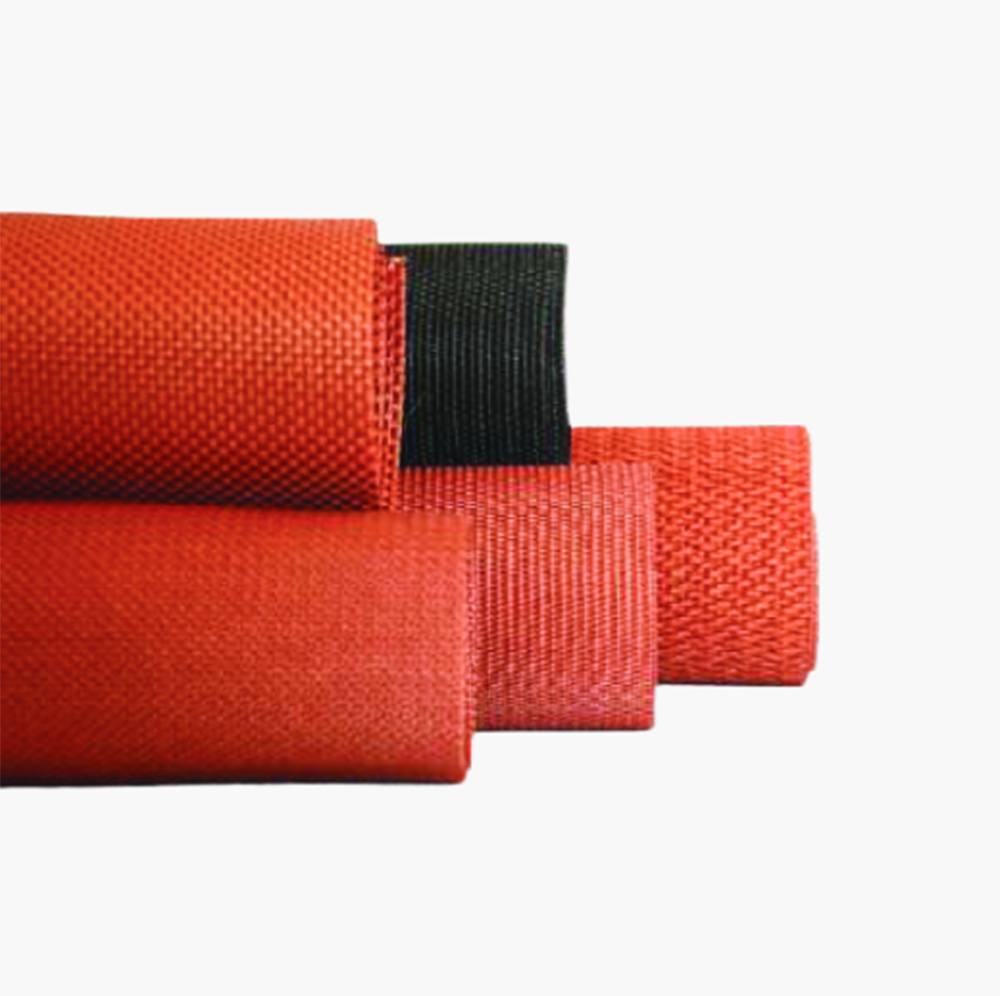
Carcass fabrics are typically woven from polyester (warp) and nylon or polyester (weft), or all-polyester constructions. Weixin specializes in all-polyester and polyester-nylon carcass fabrics optimized for industrial conveying.
Property #1: Impact Resistance
Why Impact Resistance Matters
When material drops onto a conveyor belt — from a chute, loader, or crusher — the carcass must absorb that impact energy without tearing or damaging the cover. Poor impact resistance leads to:
Cover punctures and gouges
Carcass rupture
Belt tracking problems
Splice failure
How Weixin Achieves Impact Resistance
Weixin carcass fabrics are engineered with specific weave structures and yarn selections to maximize impact energy absorption.
Key design factors:
| Factor | Impact on Impact Resistance | Weixin Approach |
|---|---|---|
| Weave type | Plain weave = higher impact resistance; tighter weaves = stiffer | Optimized plain or modified plain weave |
| Warp/weft ratio | Balanced weft (cross-direction) improves impact | Engineered weft density for drop zone conditions |
| Yarn tenacity | Higher tenacity resists rupture | High-tenacity polyester (≥ 6.5 cN/dtex) |
| Yarn elongation | Higher elongation absorbs more energy | Controlled 12–16% elongation at break |
| Fabric thickness | Thicker = more impact absorption | Grade-specific thickness options |
Impact test comparison (drop weight method, energy to rupture):
| Fabric Type | Impact Energy to Rupture (J/mm) |
|---|---|
| Standard polyester fabric | 8–10 J/mm |
| Weixin impact-resistant grade | 14–18 J/mm |
Weixin fabrics provide up to 80% higher impact resistance than standard constructions.
Application Recommendation by Impact Severity
| Impact Level | Typical Material | Weixin Fabric Recommendation |
|---|---|---|
| Low | Dry, fine powders (cement, flour) | Standard polyester carcass |
| Medium | Gravel, coal, aggregate | Impact-resistant grade |
| High | Large rocks, sharp ore, heavy lumps | Heavy-duty impact grade + impact bar support |
Property #2: Ply Adhesion
Why Ply Adhesion Matters
Multi-ply conveyor belts have two or more carcass plies bonded together with rubber skim coat. Ply adhesion is the force required to separate those plies. Poor adhesion leads to:
Ply separation and belt swelling
Edge fraying and moisture ingress
Premature belt failure
Splice weakness
How Weixin Achieves High Ply Adhesion
Adhesion between carcass fabric and rubber depends on three factors: dip chemistry, dip penetration, and fabric surface characteristics.
Weixin adhesion engineering:
| Factor | Weixin Method | Result |
|---|---|---|
| RFL dip formulation | Customized for rubber compound (NR, SBR, etc.) | Chemical bond between fabric and rubber |
| Dip pick-up control | Precision application (4–8% by weight) | Consistent adhesion without stiffness |
| Heat-setting | Multi-zone temperature control | Stabilized dip, no over-curing |
| Fabric weave | Balanced for dip penetration | Adhesion throughout ply structure |
Adhesion test results (H-pull method, ISO 36):
| Fabric Type | Ply Adhesion (N/mm) |
|---|---|
| Minimum DIN/ISO standard | ≥ 4.5 N/mm |
| Standard dipped polyester | 5.5–6.5 N/mm |
| Weixin optimized adhesion grade | 7.0–8.5 N/mm |
Weixin fabrics consistently exceed industry adhesion minimums by 50% or more.
Factors That Degrade Ply Adhesion (and How Weixin Prevents Them)
| Risk Factor | Problem | Weixin Solution |
|---|---|---|
| Over-curing during dipping | Dip becomes brittle | Precise oven temperature control |
| Under-curing | Dip does not bond fully | Multi-zone heat-setting validation |
| Dip pick-up variation | Spotty adhesion | In-process dip weight monitoring |
| Fabric contamination | Poor bonding | Clean weaving and handling |
| Moisture in fabric | Steam voids at bond line | Dried before dipping |
Property #3: Low Elongation
Why Low Elongation Matters
When a conveyor belt starts under tension, the carcass stretches. High elongation requires more take-up travel, reduces belt stability, and can cause:
Belt sag between idlers
Poor tracking
Increased take-up tension requirements
Splice creep
Longer stopping distances
Low elongation means the belt responds immediately to drive tension without excessive stretch.
How Weixin Achieves Low Elongation
Elongation is primarily controlled by warp yarn properties and heat-setting.
Weixin low-elongation engineering:
| Method | Effect on Elongation |
|---|---|
| High-tenacity, low-stretch polyester warp | Baseline elongation ≤ 12% |
| Controlled weaving tension | Uniform yarn orientation |
| Multi-zone heat-setting under tension | Locks in low elongation |
| Post-setting relaxation | Removes residual stresses |
Elongation comparison (at 10% of breaking load):
| Fabric Type | Elongation at 10% of rated tensile |
|---|---|
| Standard polyester (untreated) | 1.2–1.8% |
| Standard dipped polyester | 0.8–1.2% |
| Weixin low-elongation grade | 0.4–0.7% |
Long-term creep comparison (after 1,000 hours at 20% of breaking load):
| Fabric Type | Creep Elongation |
|---|---|
| Standard polyester | 0.8–1.2% |
| Weixin low-elongation grade | < 0.3% |
Lower elongation means less take-up travel, better tracking, and longer splice life.
Weixin Conveyor Belt Carcass Fabric Product Range
| Grade | Construction | Tensile Strength (N/mm) | Elongation at 10% | Adhesion (N/mm) | Impact Resistance | Typical Applications |
|---|---|---|---|---|---|---|
| Weixin C-200 | Polyester-polyester | 200 | 0.6% | ≥ 7.0 | Good | Light-duty, packaging, food |
| Weixin C-315 | Polyester-polyester | 315 | 0.5% | ≥ 7.5 | Good | General purpose, aggregate |
| Weixin C-400 | Polyester-polyester | 400 | 0.5% | ≥ 7.5 | Good | Medium-duty, coal, sand |
| Weixin C-500 | Polyester-nylon (EP) | 500 | 0.6% | ≥ 7.0 | Very good | Heavy-duty, mining, quarry |
| Weixin C-630 | Polyester-nylon (EP) | 630 | 0.6% | ≥ 7.0 | Very good | Heavy-duty, large lump |
| Weixin C-800 | Polyester-nylon (EP) | 800 | 0.5% | ≥ 7.0 | Excellent | Extreme heavy-duty |
| Weixin IR | Impact-resistant grade | Custom | 0.5–0.7% | ≥ 7.5 | Excellent | Drop zones, crusher feed |
EP = Polyester warp, nylon weft
The Weixin Manufacturing Advantage
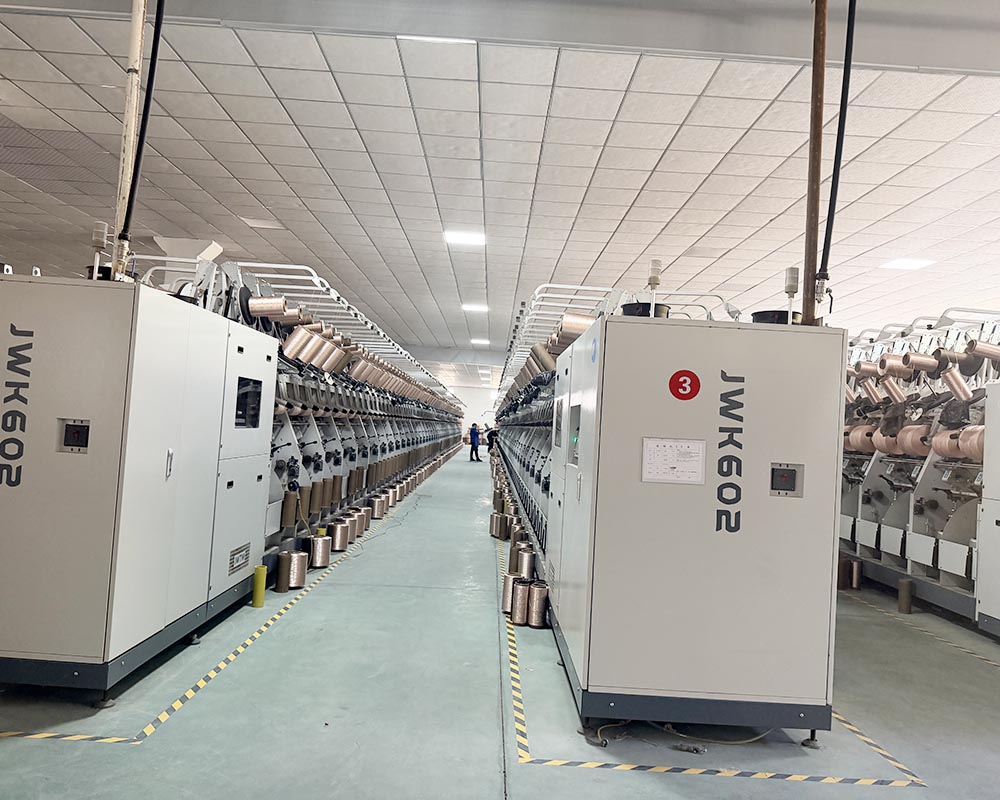
Weixin produces conveyor belt carcass fabrics on an integrated weaving, dipping, and heat-setting line:
Step 1: Yarn Selection
High-tenacity, heat-stabilized polyester
Controlled shrinkage and elongation properties
Step 2: Weaving
Precision looms with consistent tension control
Custom weave patterns for impact or adhesion priorities
Step 3: RFL Dipping
Formulation matched to customer rubber compound
Controlled dip pick-up (4–8% by weight)
No under-dipping or over-dipping
Step 4: Multi-Zone Heat-Setting
Tension-controlled to lock low elongation
Temperature-controlled to optimize adhesion
Uniform setting across full fabric width
Step 5: Final Inspection
Tensile strength verification
Adhesion testing per batch
Elongation measurement
Width and thickness check
Quality Assurance and Traceability
Every Weixin carcass fabric shipment includes:
Batch-specific tensile test report
Adhesion test results (H-pull)
Elongation at specified loads (1%, 2%, 5%, 10%)
Thermal shrinkage data
Fabric width and thickness certificate
Traceability code to raw yarn lots
Selection Guide: Matching Carcass Fabric to Application
| Conveyor Application | Recommended Weixin Grade | Key Priority |
|---|---|---|
| Light duty, package handling | C-200 | Low cost, adequate strength |
| Grain, cement, dry powders | C-315 or C-400 | Low elongation, good troughability |
| Coal, sand, gravel | C-500 or C-630 | Impact + adhesion + low elongation |
| Mining, large rock, ore | C-800 or IR grade | Maximum impact resistance |
| Crusher feed, drop zones | IR (impact-resistant) | Energy absorption |
| Long overland conveyors | C-400 to C-800, low-elongation grade | Minimum take-up travel |
Case Example: Quarry Replaces Carcass Fabric, Reduces Belt Failures
Company: Limestone quarry with 2,000-meter overland conveyor
Previous fabric: Standard EP 630 (polyester-nylon)
Problem: Frequent impact tears at load zone (6–8 tears per year), plus belt elongation requiring quarterly re-tensioning
Solution: Weixin C-630 with impact-resistant weave + low-elongation heat-setting
Results after 12 months:
Impact tears: reduced from 7 to 1 (86% reduction)
Belt elongation: from 1.2% to 0.5% at operating tension
Take-up adjustment frequency: from quarterly to annually
Unplanned downtime: reduced by 34 hours per year
Estimated savings: $68,000 in reduced repairs and downtime
Why Conveyor Belt Manufacturers Choose Weixin
Engineered balance – Impact resistance, ply adhesion, and low elongation combined
Consistent batch quality – Statistical process control on every roll
Custom formulations – Dip matched to your rubber compound
Technical support – Fabric selection based on your belt construction and operating conditions
Full traceability – Complete documentation from yarn to finished fabric
Global supply – Reliable lead times and inventory planning
Conclusion
Conveyor belt carcass fabric is not a commodity. It is an engineered reinforcement that must deliver impact resistance to survive load zones, ply adhesion to prevent delamination, and low elongation to maintain belt stability. Weixin polyester carcass fabrics are designed to achieve all three.
Do not compromise on the backbone of your belt. Specify Weixin.
Contact Weixin today to discuss your carcass fabric requirements, request technical datasheets, or order sample rolls for testing.
Our Expertise – Carcass Fabric & Dipped Fabric Solutions
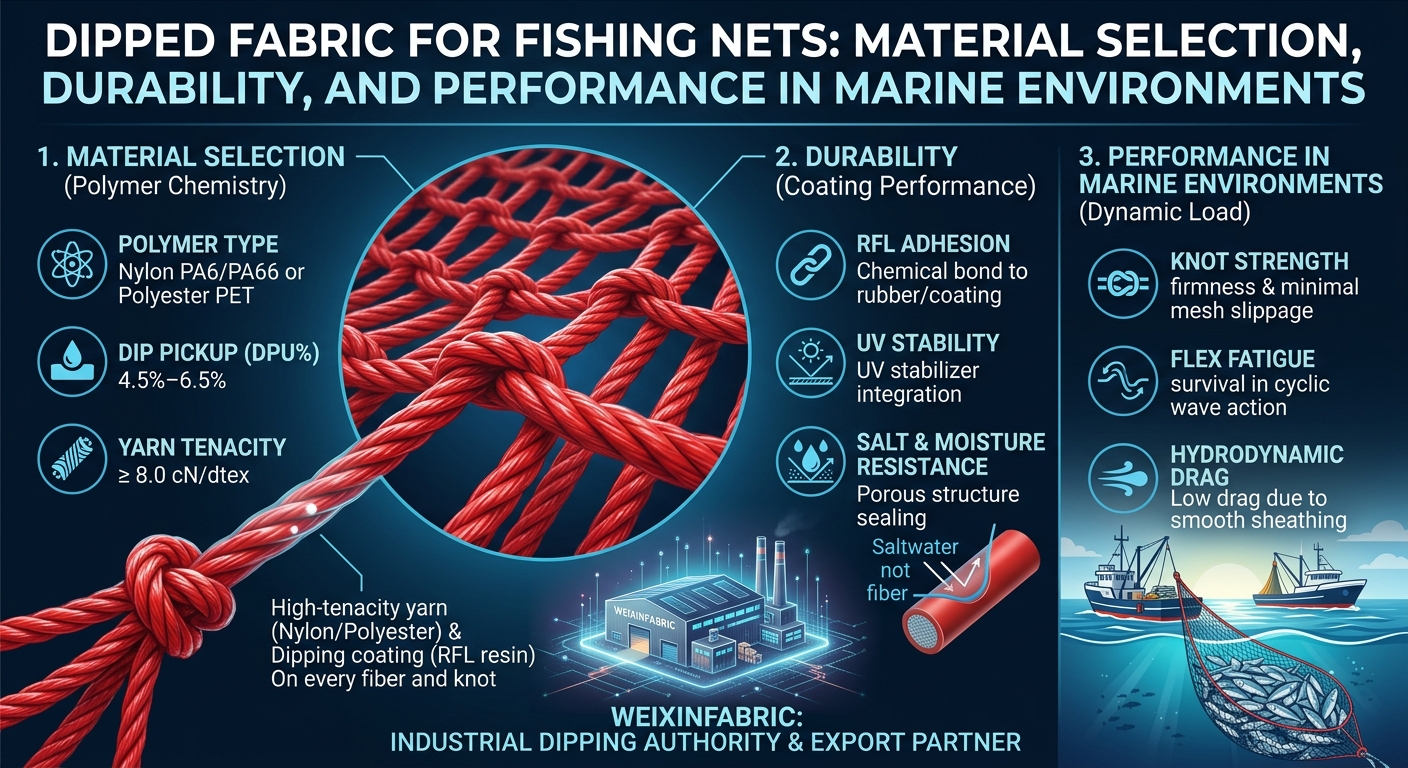
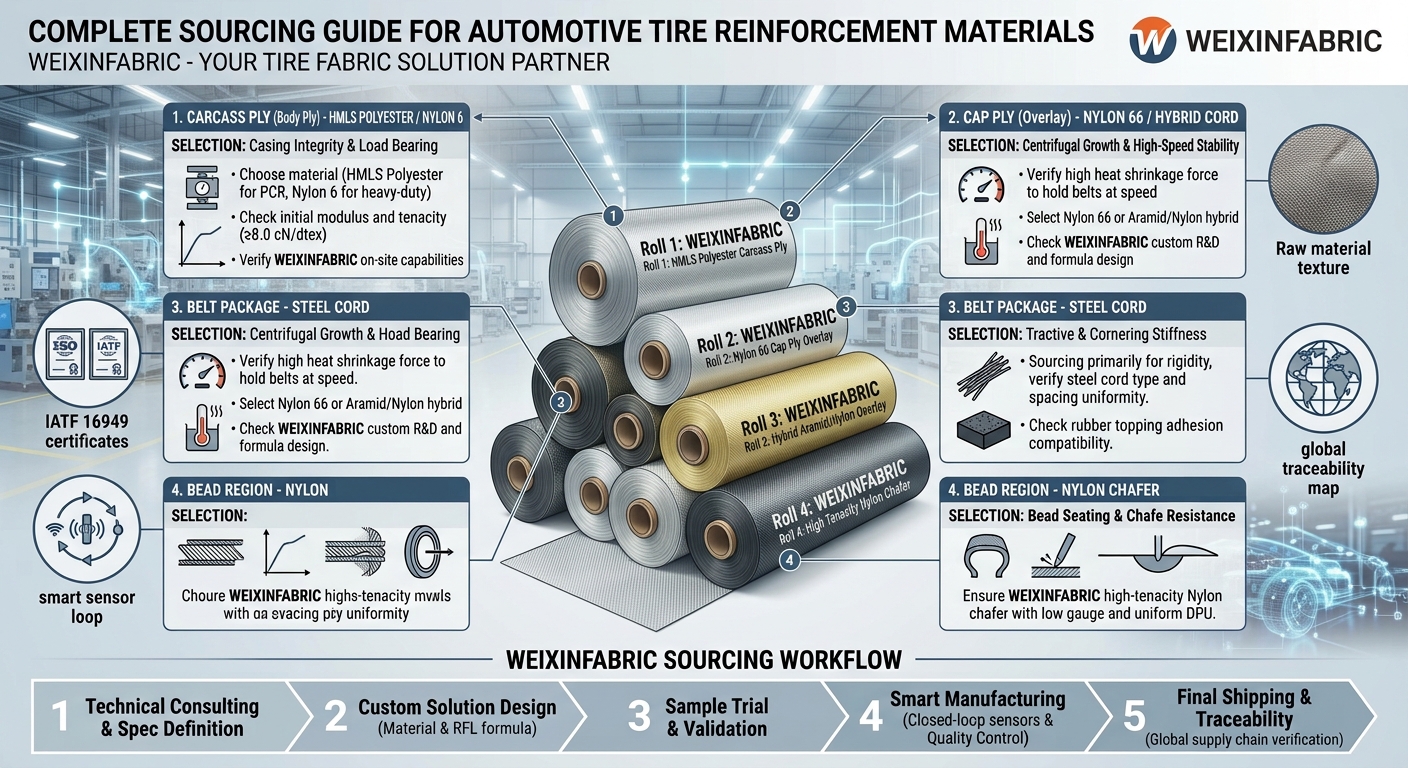
As a professional manufacturer and solution expert, we specialize in Carcass Fabric for Automotive Tires, Dipped Fabric for Conveyor Belts, Dipped Fabric for Fishing Nets, and Grade C Cord Fabric. With years of R&D and production experience, we provide high-strength, heat-resistant, and durable industrial fabrics tailored to global clients' specific requirements. Our products are widely used in tire reinforcement, conveyor belt carcass, fishing net manufacturing, and other industrial applications. Explore full product range →
Also check our Tire Cord Fabric, Conveyor Belt Dipped Fabric, and Fishing Net Dipped Fabric pages.