How Fabric Construction (EP vs NN) Affects Conveyor Belt Tension Rating and Elongation
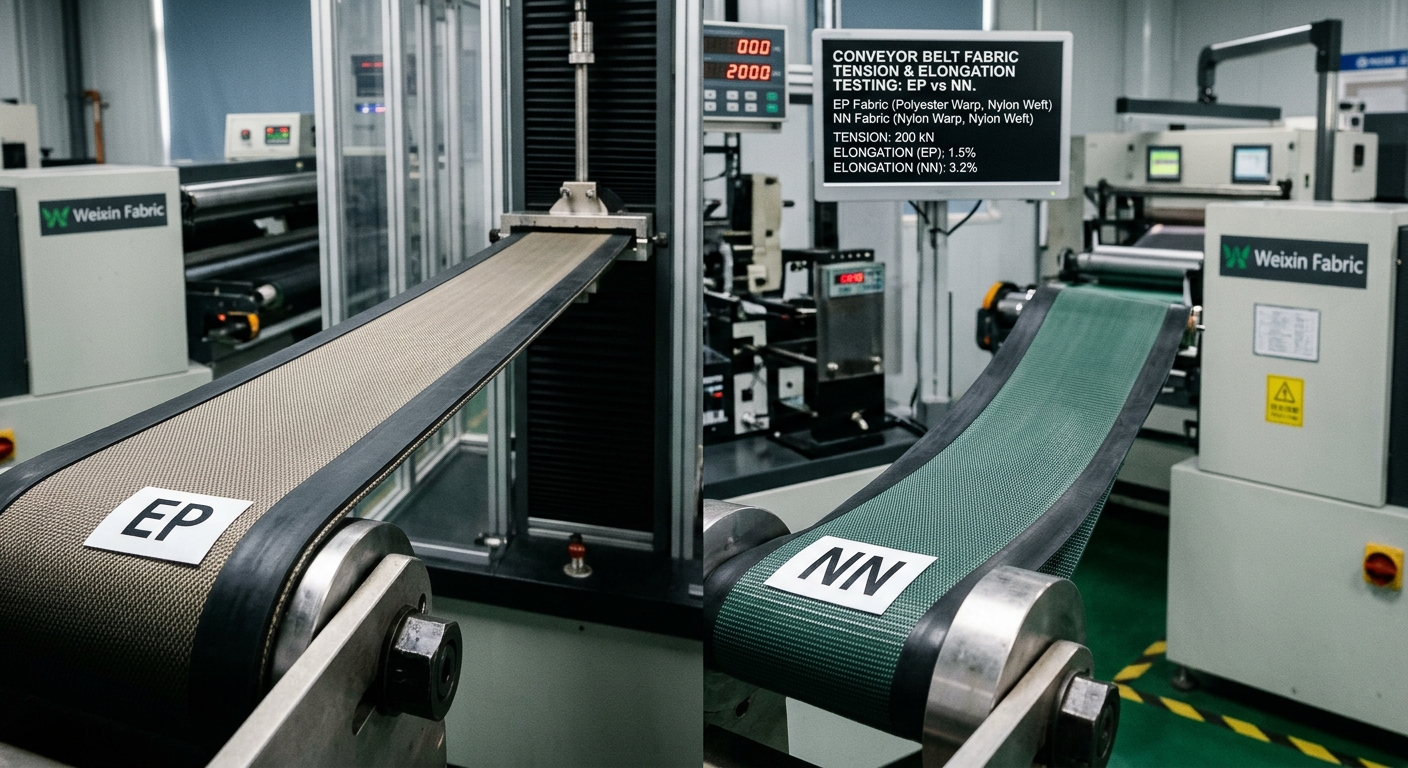
In heavy-duty material handling and bulk transport systems, the conveyor belt carcass serves as the structural load-bearing backbone. Selecting the correct reinforcement fabric directly dictates the belt's tensile strength, operating elongation, troughability, and impact resistance. Among industrial textile options, EP (Polyester-Nylon) and NN (Nylon-Nylon) duck fabrics dominate the market, yet their distinct polymer characteristics create entirely different mechanical behaviors under tension. As a leading Chinese manufacturing enterprise specializing in high-performance industrial fabrics, Weixin Fabric delivers an in-depth technical analysis comparing EP and NN carcass constructions. This paper evaluates warp and weft tensile ratings, initial and working elongation, troughability indices, and moisture absorption properties to guide engineers in optimizing conveyor belt design. The core difference between EP and its nylon counterpart lies in the yarn combination utilized in the warp (longitudinal) and weft (transverse) directions: Tensile strength ratings define the maximum working load a conveyor belt can sustain without permanent carcass deformation or joint failure: Engineering Principle: High-modulus polyester warp yarns in EP fabrics allow higher tension ratings per ply, making EP belts ideal for long-distance, high-capacity overland conveyors where low stretch is critical. Because polyester exhibits minimal creep under sustained high loads, EP conveyor belts maintain constant tension over long center-to-center distances. This reduces take-up travel distance requirements and prevents belt slippage on drive pulleys. NN fabrics excel in short-to-medium distance applications subjected to heavy impact loading, such as primary rock crushers and mining transfer points. The high elongation-at-break of nylon absorbs kinetic shock energy, preventing carcass cracking. Understanding elongation behavior is critical for designing proper take-up strokes and preventing splice separation: The engineering matrix below outlines the mechanical differences between EP and NN fabric reinforcements: Selecting the correct carcass reinforcement fabric is essential for maximizing conveyor belt service life, reducing maintenance downtime, and preventing catastrophic splice failures. Substandard fabric construction leads to excessive belt stretch, tracking errors, and premature wear. Weixin Fabric is an established Chinese manufacturing enterprise specializing in high-performance industrial fabrics, including premium EP conveyor belt fabric, NN nylon duck fabric, and specialized reinforcement textiles. Engineered with strict dimensional control, high tensile strength, and exceptional adhesion properties, Weixin Fabric empowers global belting manufacturers to produce durable, high-performance conveyor systems. Optimize your conveyor belt design and elevate structural performance. Contact Weixin Fabric today for specialized technical consultations and custom industrial fabric solutions.1. Polymer Characteristics and Structural Mechanics of EP vs. NN
2. Tension Ratings and Load-Bearing Capacity
A. High Modulus and Low Stretch in EP Carcasses
B. Elasticity and Shock Absorption in NN Carcasses
3. Elongation Analysis: Initial vs. Working Elongation
Comparative Performance Matrix: EP vs. NN Conveyor Belt Fabrics
Mechanical Parameter EP Fabric (Polyester / Nylon) NN Fabric (Nylon / Nylon) Optimal Application Field Tensile Strength / Modulus High modulus, low stretch Moderate modulus, high elasticity EP: Long overland systems / NN: Short heavy impact Working Elongation Low (< 1.5% at working load) Higher (2.0% – 3.5% at working load) EP minimizes take-up travel requirements Impact & Tear Resistance Good (enhanced by nylon weft) Superior (high nylon elasticity) NN excels in high-impact mining crushers Moisture Absorption Very low (< 0.4%, excellent wet strength) Higher (~4% moisture regain, wet strength loss) EP is superior in humid or wet environments Weixin Fabric: Professional Industrial Fabric Solution Experts
Our Expertise – Carcass Fabric & Dipped Fabric Solutions
As a professional manufacturer and solution expert, we specialize in Carcass Fabric for Automotive Tires, Dipped Fabric for Conveyor Belts, Dipped Fabric for Fishing Nets, and Grade C Cord Fabric. With years of R&D and production experience, we provide high-strength, heat-resistant, and durable industrial fabrics tailored to global clients' specific requirements. Our products are widely used in tire reinforcement, conveyor belt carcass, fishing net manufacturing, and other industrial applications. Explore full product range →
Also check our Tire Cord Fabric, Conveyor Belt Dipped Fabric, and Fishing Net Dipped Fabric pages.