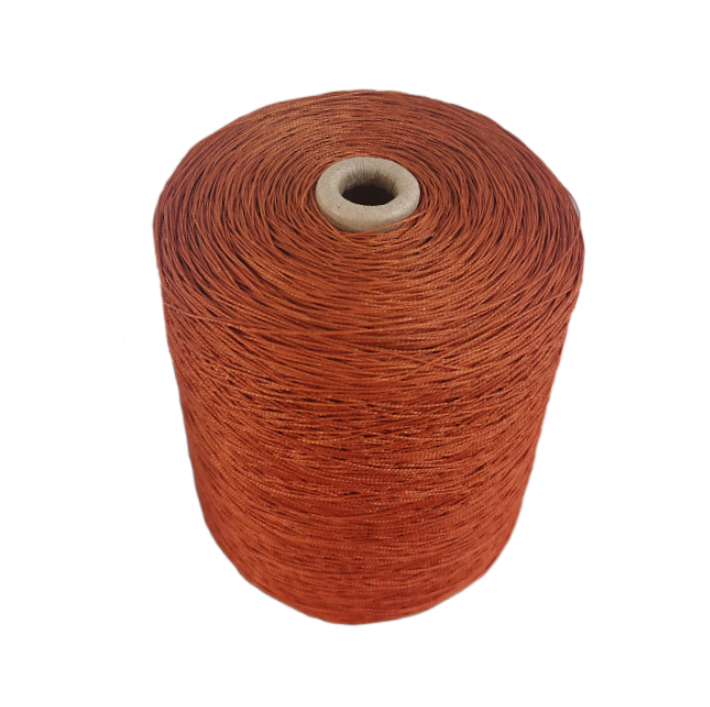
Inside Our Dipping Line: How Consistent Tension Control Improves Your Fishing Net Strength?
For commercial fishing operations, net failure isn't just an inconvenience — it's a direct hit to revenue and safety. The difference between a net that lasts three seasons versus one that frays after six months often comes down to a hidden variable: consistent tension control during the dipping process. At Weixin Fabric, our dipping line isn't just about applying RFL (Resorcinol-Formaldehyde-Latex) treatment — it's a precision system where every centimeter of cord experiences identical mechanical stress. This article takes you inside our factory to reveal how tension uniformity directly translates into superior fishing net knot strength, UV resistance, and ultimate breaking force.
1. Why Tension Control Matters in Dipped Fishing Net Fabric
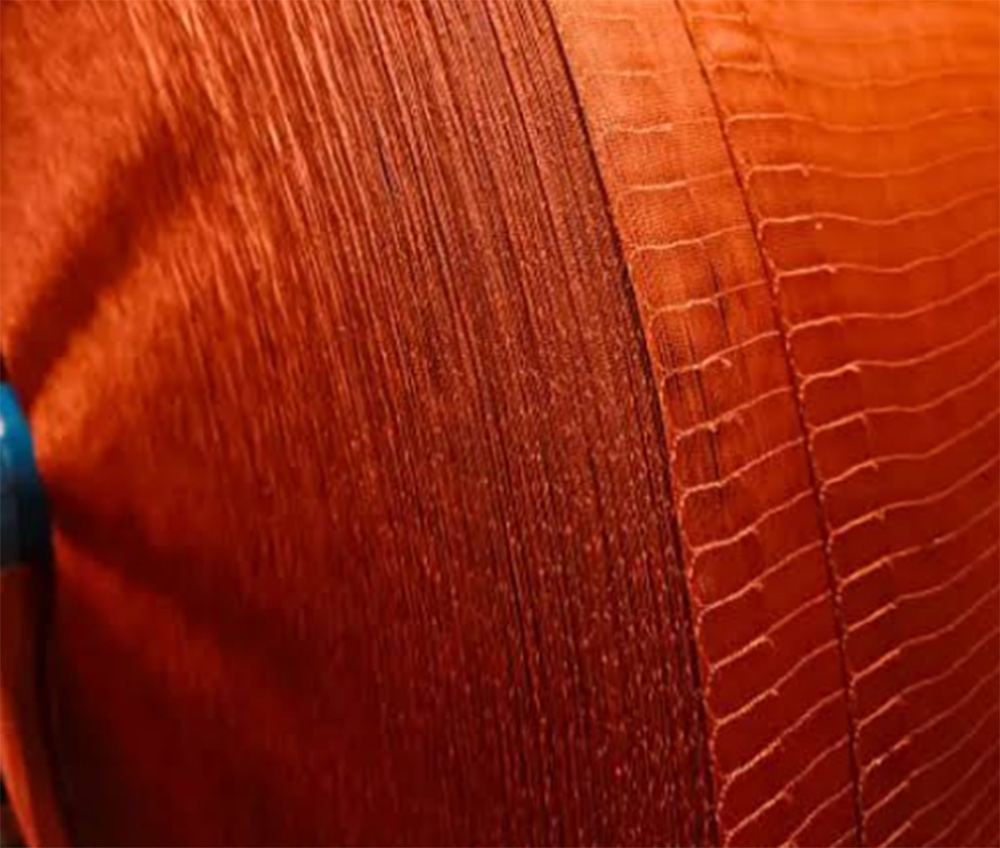
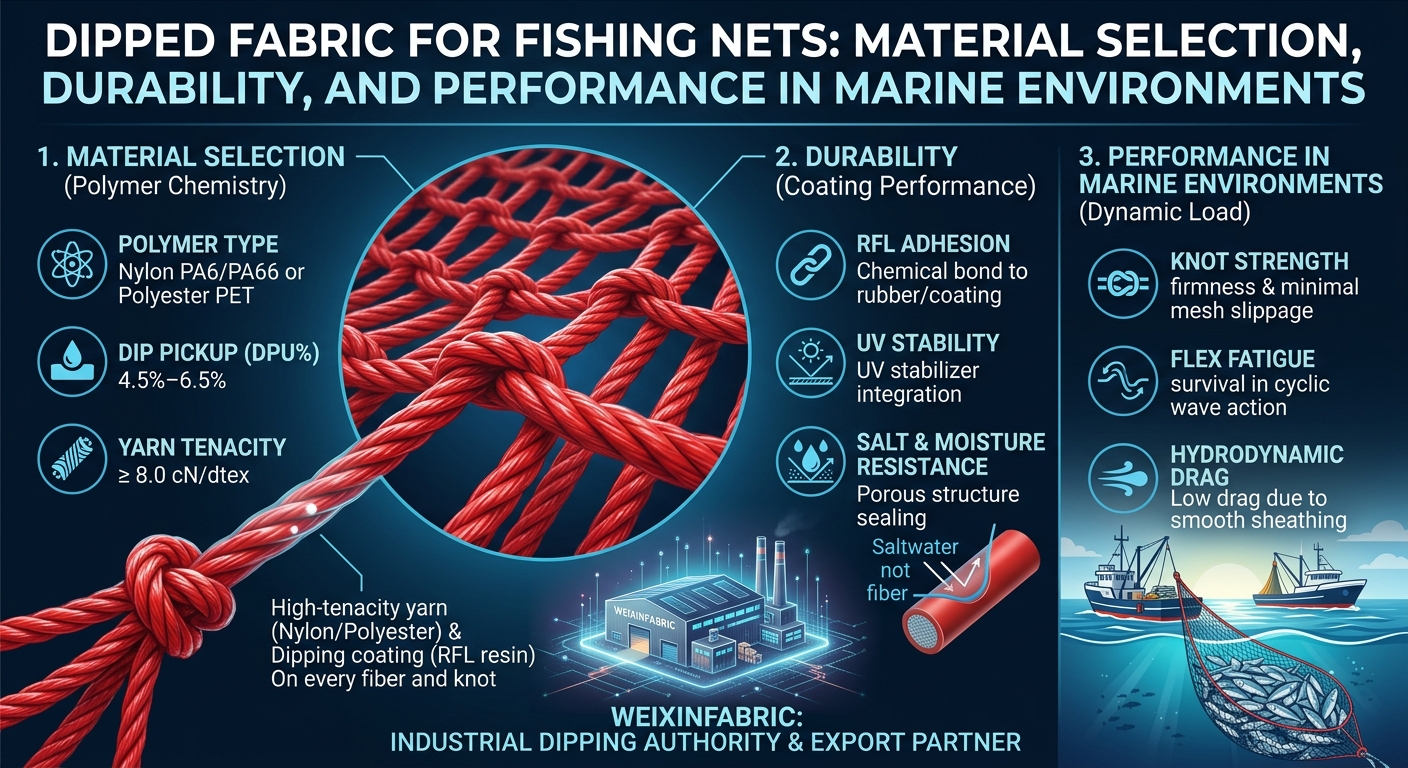
Fishing nets rely on dipped fabric (also called netting twine or cord fabric) that must endure saltwater, UV radiation, abrasion against rocks, and sudden dynamic loads. The dipping process impregnates each filament with a bonding agent that protects against environmental attack and improves knot retention. However, if tension varies across the fabric width or along the length, the dip pick-up (DPU) becomes uneven. Low-tension zones absorb excessive dip (becoming stiff and brittle), while over-tensioned zones get insufficient penetration, leading to premature fraying. Consistent tension ensures uniform coating thickness and optimal rubber/coating adhesion — the foundation of net strength.
2. Inside Our Dipping Line: Closed-Loop Tension System
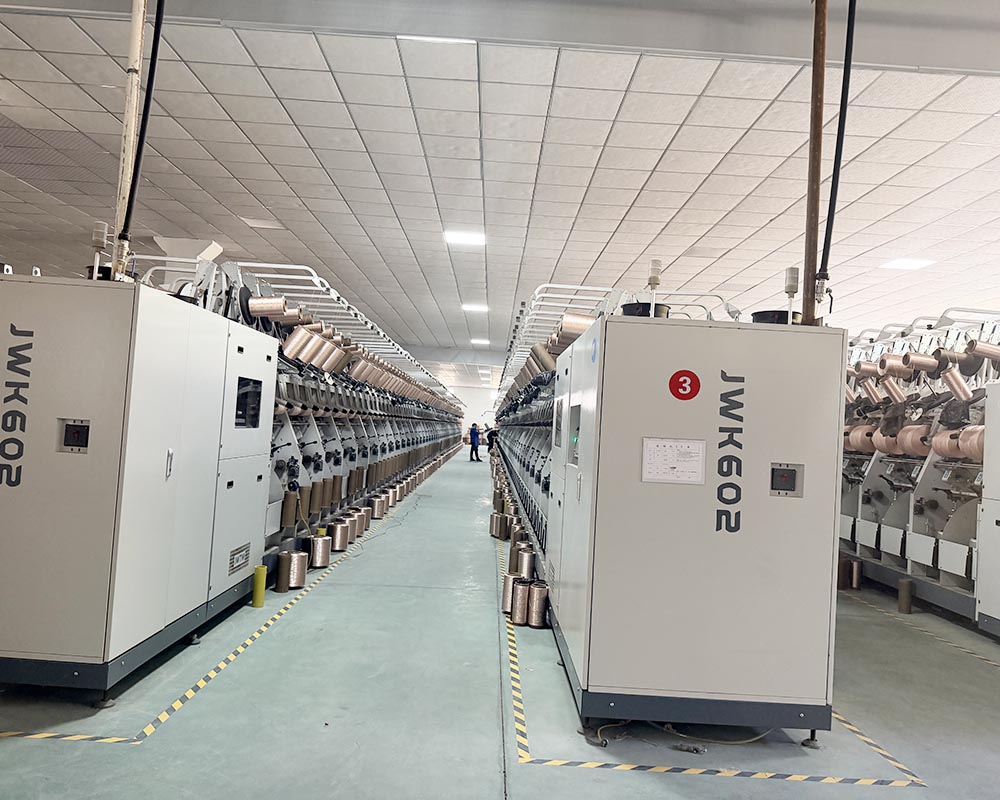
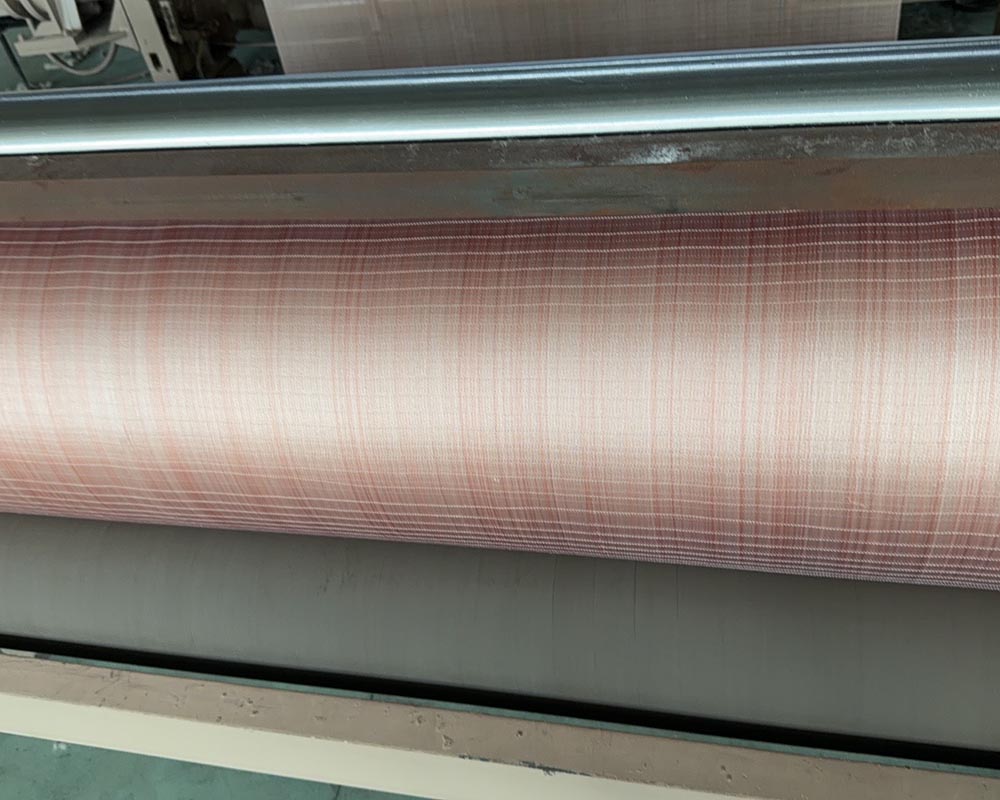
Our dipping line operates 24 hours a day, three shifts, with real-time sensors monitoring tension at every stage: let-off, dip bath, drying zones, and take-up. The process starts with high-tenacity polyester or nylon industrial yarns, which pass through multiple tension-controlled rollers before entering the RFL bath. An automated PLC system adjusts roller speed and braking torque within ±0.5% of setpoint, eliminating drift that plagues older machinery. After dipping, the fabric moves through a six-zone drying oven where tension remains constant to prevent shrinkage distortions. Finally, a precision winder packages the finished dipped fabric with uniform density — no soft or hard spots that later cause net assembly issues.
3. From Tension Uniformity to Fishing Net Performance
🔗 Knot Strength Enhancement
In a fishing net, knots are the most stressed points. Unevenly dipped cord creates localized abrasion inside the knot — the coating cracks prematurely. Our consistent tension yields a flexible yet tough dip film that slides smoothly during knot tightening, then locks without micro-fractures. Laboratory tests show that dipped fabric from our line achieves knot strength retention of 92-95% compared to straight tensile strength, versus 75-80% from conventional processes.
☀️ UV & Saltwater Resistance
Uniform dip pick-up ensures every filament is shielded from UV degradation. Inconsistent dipping leaves "bald spots" where UV penetrates, weakening the yarn. After 500 hours of accelerated UV exposure (simulating one year of tropical sun), our tension-controlled dipped fabric retains >85% of original strength, while poorly controlled samples drop below 60%.
💪 Breaking Force Consistency
For net manufacturers, batch-to-batch consistency is non-negotiable. Our tension control system records digital profiles for each roll, so you receive dipped fabric with ≤1.5% coefficient of variation (CV) in breaking strength. This means predictable net assembly and reliable catch capacity.
4. Technical Comparison: Tension-Controlled vs. Conventional Dipping
| Parameter | Conventional Dipping (variable tension) | Weixin Precision Tension Control | Impact on Fishing Net |
|---|---|---|---|
| Dip pick-up uniformity (%) | ±15% variation | ±3% variation | Eliminates brittle/stiff zones |
| Knot strength retention | 75-80% | 92-95% | Fewer net ruptures at knots |
| UV resistance (500h, strength retained) | 55-65% | 85-90% | Longer field life in marine environment |
| Breaking strength CV (batch-to-batch) | 5-8% | ≤1.5% | Predictable net design & safety margin |
5. Real-World Impact: Customer Case
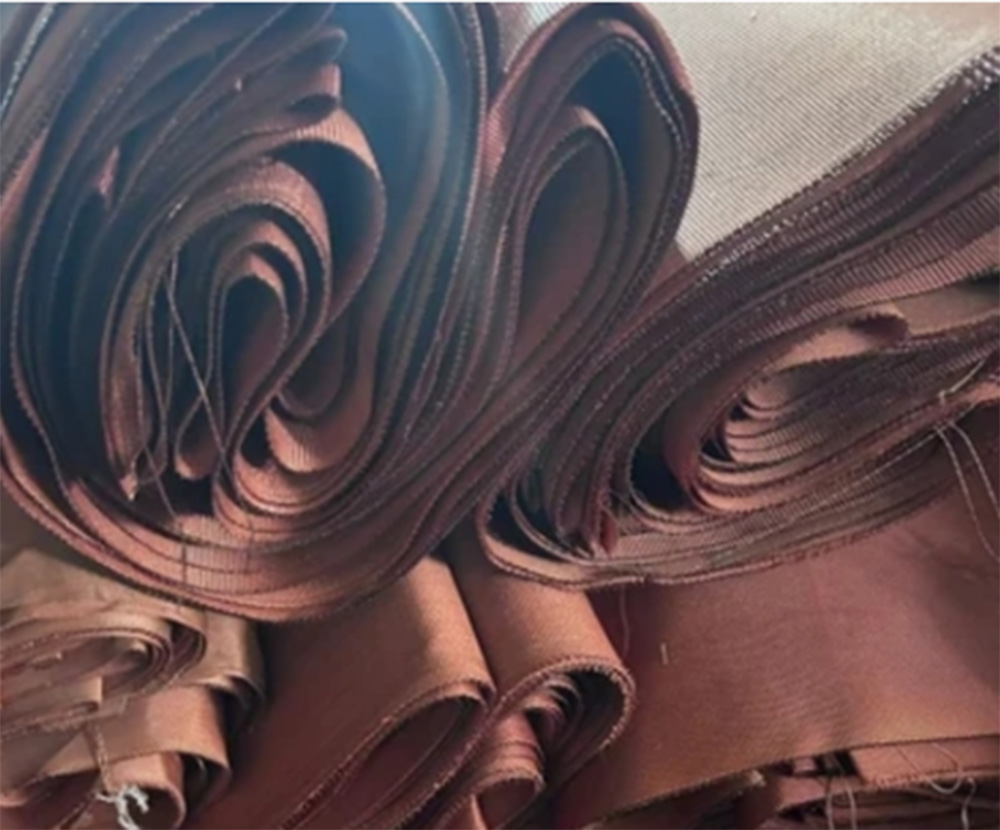
A Vietnamese fishing net manufacturer previously sourced dipped nylon cord from a supplier with inconsistent tension. Their nets often failed after 8-10 months, particularly around knots and splices. After switching to Weixin Fabric's tension-controlled dipped cord (Grade C Nylon specifically for fishing nets), their net lifespan increased to 22 months. Moreover, the uniformity allowed them to reduce safety margins and produce lighter nets with the same catch strength, saving fuel costs for fishing vessels.
6. Why Weixin Fabric’s Dipping Line is Different
Our commitment to tension control goes beyond equipment. We implement:
- Real-time data logging: Every roll has a digital tension profile, available on request.
- Weekly calibration: All tension sensors are calibrated against NIST-traceable standards.
- 100% visual and automated inspection: Cameras and laser sensors detect surface anomalies caused by tension fluctuations.
- Customizable tension recipes: Different fishing net applications (trawling vs. gillnet vs. aquaculture) require tailored dip pickup — we adjust tension profiles accordingly.
Whether you need polyester dipped fabric for seine nets or nylon cord for longlines, our dipping line delivers the consistency that translates directly to higher fishing net strength, longer service intervals, and lower replacement costs.