Top 8 Quality Control Tests for Tire Carcass Fabric Every Buyer Should Know
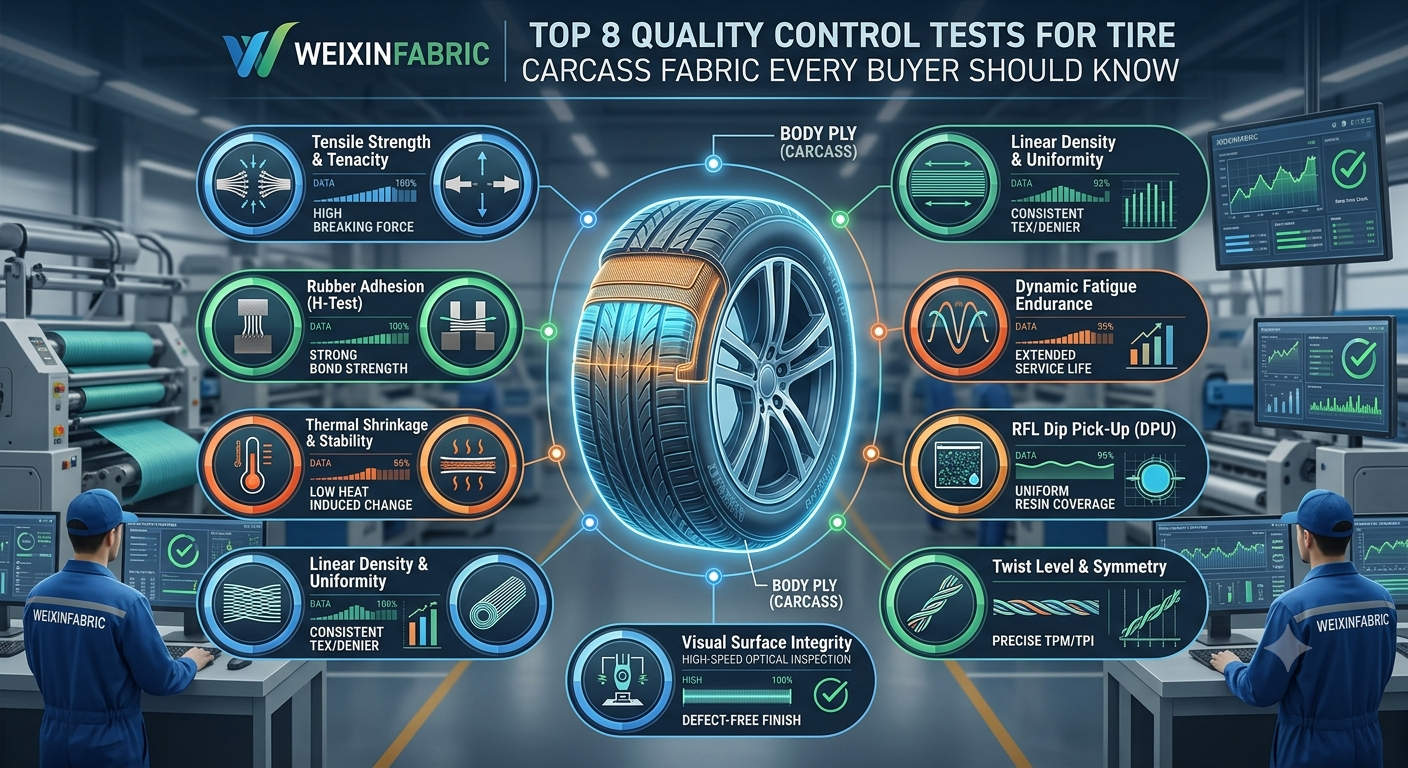
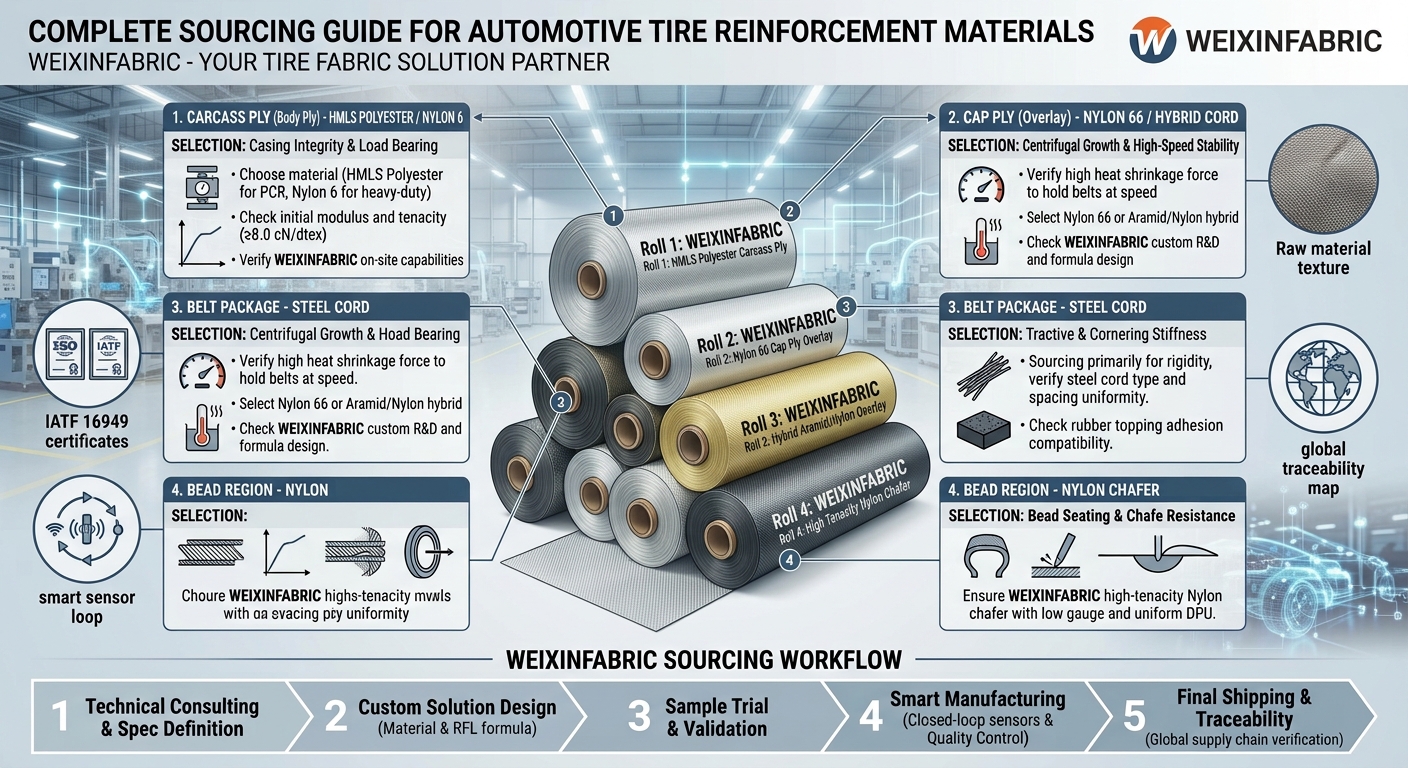
Industrial Procurement & Quality Assurance Guide by Weixin Fabric In high-performance automotive manufacturing, tire safety and casing durability depend heavily on the quality of the inner carcass reinforcement layer. The carcass fabric—engineered from specialized synthetic polymers like High-Tenacity Nylon 66 or High-Modulus Low-Shrinkage (HMLS) Polyester—acts as the load-bearing framework that holds structural inflation pressure and withstands severe road impacts. Procurement managers and tire development engineers must ensure that raw fabric deliveries meet strict physical, chemical, and mechanical tolerances prior to calendering and vulcanization. As a leading Chinese manufacturer specializing in premium automotive tire carcass fabrics, Weixin Fabric enforces comprehensive Quality Assurance (QA) and Quality Control (QC) protocols. To help international tire manufacturers and procurement teams audit material quality effectively, our technical engineering team has compiled the 8 critical quality control tests every tire fabric buyer must know. 1. Tensile Strength and Elongation Test (ASTM D885 / ISO 2062) 2. Rubber-to-Fabric Adhesion Test (H-Test & Strap Peel Test) 3. Thermal Shrinkage and Shrinkage Force Test 4. Dynamic Fatigue Resistance Test (De Mattia & Goodrich Flexometer) 5. Dip Pick-Up (DPU %) and Chemical Coating Thickness Test 6. Linear Density and Mass Uniformity Test (dtex / Denier) 7. Twist Level and Direction Test (TPI / TPM) 8. Moisture Content and Environmental Regain Test The matrix below summarizes standard testing parameters and quality benchmarks applied by Weixin Fabric to guarantee tier-1 automotive performance: Implementing rigorous quality control testing at the raw material stage eliminates downstream manufacturing losses. Substandard carcass fabric leads to high tire defect rates during vulcanization, including internal ply separation, uneven radial force variation (RFV), and premature field blowouts. By partnering with an established Chinese factory like Weixin Fabric, global buyers gain access to fully certified, batch-tested carcass fabric rolls accompanied by complete Mill Test Certificates (MTC) for every shipment. Understanding these top 8 quality control tests empowers tire buyers to make informed purchasing decisions and secure reliable reinforcement materials. Based in China, Weixin Fabric is dedicated to delivering world-class tire carcass fabric, offering custom dipped formulations, high-tenacity yarn constructions, and comprehensive QA testing for global tire OEMs. Contact our engineering and sales team today to request product samples, mill inspection reports, or custom technical evaluations tailored to your tire manufacturing specifications.Top 8 Quality Control Tests for Tire Carcass Fabric Every Buyer Should Know
The 8 Essential Quality Control Tests for Carcass Fabric
This test measures the breaking force (tenacity) and elongation at specified loads (EASL) of single tire cords. Evaluating ultimate tensile strength guarantees that the carcass can withstand maximum pneumatic burst pressure without structural failure.
Interfacial bond strength between the dipped fabric and skim rubber compound is critical. Utilizing the H-pull test (ASTM D4776) and T-peel test (ASTM D4393), engineers measure the force required to strip cords from vulcanized rubber, ensuring long-term resistance to inter-ply delamination.
Subjecting dipped tire cord fabric to high vulcanization temperatures (typically 177°C to 180°C) evaluates thermal stability. Precise control over thermal shrinkage prevents tire distortion, sidewall indentation, and dimensional instability during hot molding.
Tire carcass fabrics experience millions of cyclic deformation loops over their service life. Dynamic fatigue testing simulates continuous bending, axial compression, and thermal heat buildup to measure cord durability under long-distance operational conditions.
The amount of Resorcinol-Formaldehyde-Latex (RFL) resin applied during dipping determines chemical affinity with rubber. Gravimetric burn-out or chemical extraction techniques verify that the DPU percentage remains within specified targets (typically 4.5%–7.0%) across the fabric width.
Verifying linear density ensures consistent cord weight and diameter across warp beams. Uniform dtex values prevent gauge fluctuations during rubber skim topping and eliminate localized weight imbalances in green tires.
Twist per inch (TPI) or turns per meter (TPM) directly influences cord modulus and fatigue behavior. Automated twist counters confirm that single and ply twist levels match engineering drawings for both S-twist and Z-twist configurations.
Excess moisture in synthetic cord fabric vaporizes during high-temperature vulcanization, causing micro-porosity and blisters in the casing. Moisture analyzers ensure the fabric is dried and sealed within moisture-proof packaging before shipment.
Standard Specifications and QC Benchmarks
QC Test Method Standard Test Method Target Quality Objective Tensile & EASL ASTM D885 / ISO 2062 High breaking force; narrow elongation tolerance (+/- 0.5%). H-Peel Adhesion ASTM D4776 / D4393 100% rubber coverage failure; high pull-out force (> 150 N). Thermal Shrinkage 177°C x 2 min (Testrite) Low shrinkage (< 3.0% for HMLS polyester; strictly controlled for Nylon). RFL Dip Pick-Up ASTM D1907 / ISO 1833 Controlled DPU range (4.5% - 7.0%) across all fabric widths.
Why Quality Control Procurement Matters for Tire Manufacturers
Conclusion: Partner with Weixin Fabric for Guaranteed Quality
Our Expertise – Carcass Fabric & Dipped Fabric Solutions
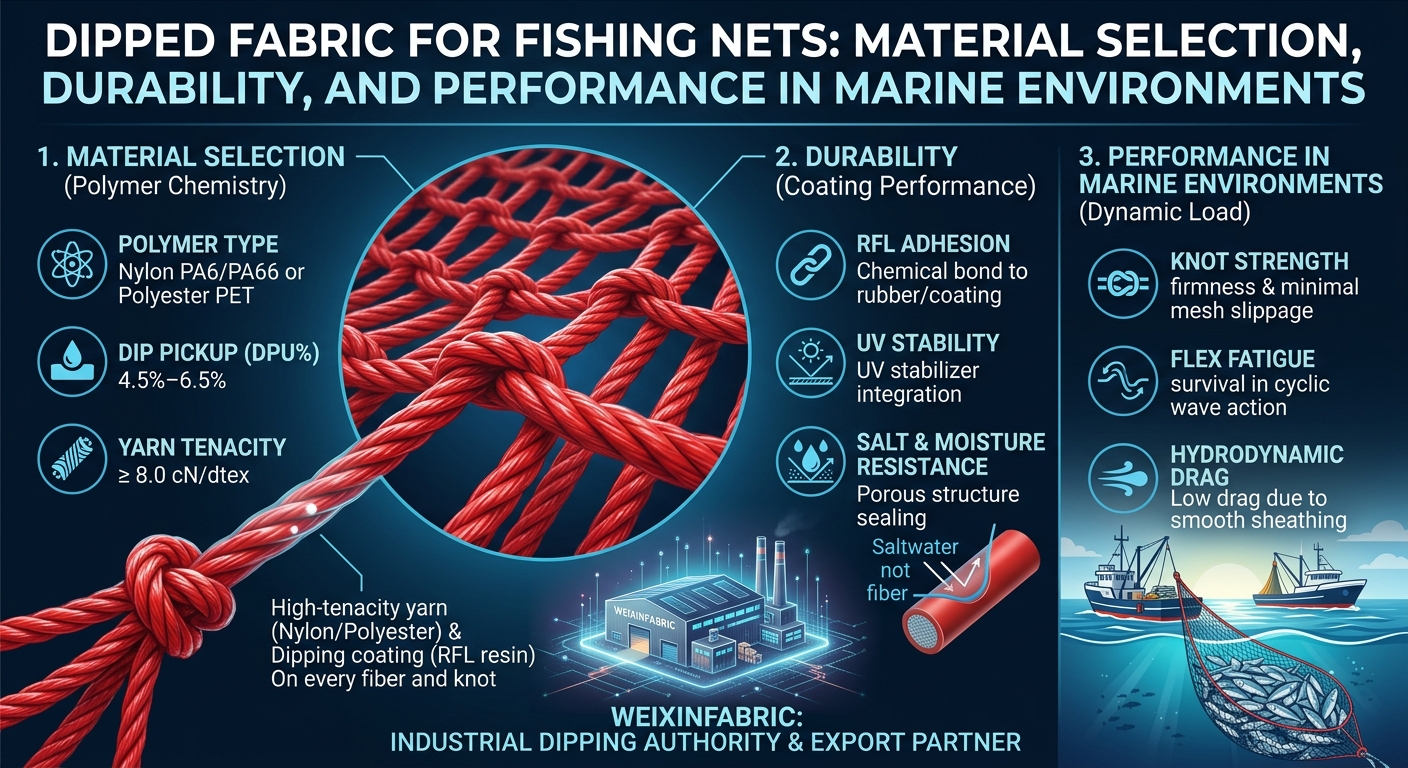
As a professional manufacturer and solution expert, we specialize in Carcass Fabric for Automotive Tires, Dipped Fabric for Conveyor Belts, Dipped Fabric for Fishing Nets, and Grade C Cord Fabric. With years of R&D and production experience, we provide high-strength, heat-resistant, and durable industrial fabrics tailored to global clients' specific requirements. Our products are widely used in tire reinforcement, conveyor belt carcass, fishing net manufacturing, and other industrial applications. Explore full product range →
Also check our Tire Cord Fabric, Conveyor Belt Dipped Fabric, and Fishing Net Dipped Fabric pages.